An enquiry is not a request for information. The sender usually knows roughly what a photographer costs and roughly what they want. What they are actually doing is finding out which of the people they wrote to is easy to deal with.
That means your first reply is not paperwork before the real work. It is the first sample of the service. If it is slow, generic, or nothing but a number, you have shown them what working with you feels like, and you have done it before they ever saw a contract.
Speed matters more than polish
Most enquiries go to several photographers at once. The one that answers first is not simply earlier, it sets the terms: everybody who replies afterwards gets read as a comparison against that message.
You do not need a perfect reply to be first. A short, human message within a few hours beats a beautifully designed one that arrives on Thursday. If you are shooting all day, send three lines from the car: yes, the date is free, here is what I will send you tonight.
Answering late is not a small sin. By the time a two-day-old reply arrives, the sender has often already decided, and your message is being read for confirmation rather than consideration.
Never send a price with nothing around it
The single most common mistake is replying with a figure and nothing else. A number alone invites exactly one response, which is to compare it with other numbers, and that is a contest you have no reason to enter.
Put the price where it belongs: after what they get, and inside a message that shows you read theirs.
The five things a first reply needs
- The date, confirmed. Say plainly whether you are free. This is the only thing they actually asked, and burying it is maddening.
- Something specific to them. Their venue, their city, the fact that it is a second wedding, the fact that the child is two. One sentence that could not appear in anyone else's reply.
- A starting point, not a full price list. What a booking with you typically involves and what it starts at. Enough to self-select, not so much that they have homework.
- One clear next step. A call, a meeting, a link to hold the date. Exactly one, not a menu.
- A reason to answer this week. Not pressure, just the truth: how long you can hold the date before someone else asks for it.
Say their event back to them
People can tell within one line whether a reply was written for them or pasted. And the fix costs almost nothing: name the venue, the date, the two names.
If the enquiry mentions anything human, respond to it as a person before you respond as a business. Somebody telling you they are nervous about being photographed has given you the most useful sentence in the entire message. Answering it directly will do more than any portfolio link.
Ask exactly one question
The temptation is to reply with a questionnaire. Do not. Every question you ask is a task you have given to somebody who has not decided to hire you yet.
Ask the one question whose answer changes what you would propose. Usually that is about time or scope: what time does the ceremony start, how many hours are you imagining, is this for the two of you or for the whole family. One question gets answered. Six get postponed until the weekend, which is when your competitor's message gets read instead.
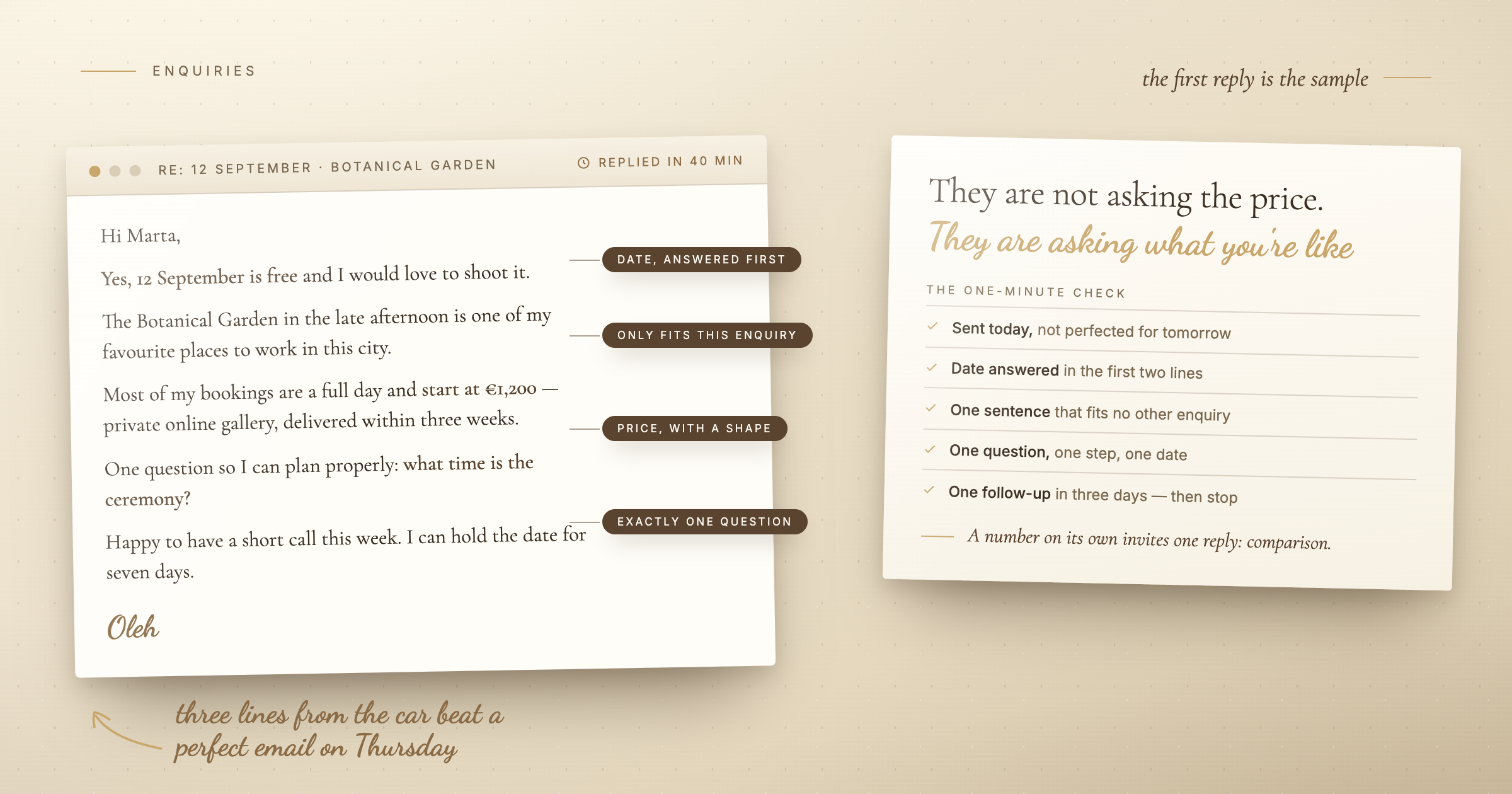
A first reply that does all of that
Hi Marta,
Yes, 12 September is free and I would love to shoot it.
The Botanical Garden in the late afternoon is one of my favourite places to work in this city, especially if we can be out there for the last hour of light.
Most of my wedding bookings are a full day, from getting ready to the first dances, and they start at 1,200 euros. I deliver a private online gallery, usually within three weeks.
One question so I can plan properly: what time is the ceremony?
If you would like, we can have a short call this week. I can hold the date for seven days without a deposit.
Oleh
Nothing in that message is clever. It answers the question, proves the message was read, gives a number with a shape around it, asks one thing, and ends with a single step and a real deadline.
The follow-up, and when to stop
Silence is usually not rejection. It is a full inbox and a busy week.
Send one follow-up, three or four days later, and make it short. Do not ask whether they received it. Add something instead: a date that has since been taken, a gallery from a similar venue, the fact that you are holding the date until Friday.
Then stop. A second chase costs you the composure that made the first reply attractive, and on the small chance they come back a year later, you want to be the photographer who was easy, not the one who nagged.
When the answer should be no
Not every enquiry is a booking worth having, and answering that quickly is a kindness to both of you.
- They lead with a discount request before knowing what is included. Price is the only thing they are buying, and there will always be somebody cheaper.
- They want "just a few photos, nothing formal" for a full day. That is a mismatch of expectations, not a small job, and it ends in disappointment.
- The date is already taken. Say so in one line and recommend someone. A good referral is remembered far longer than a polite maybe.
Declining quickly and warmly is not lost business. The people you turn down talk to the people you want.
The one-minute check before you hit send
- Date question answered in the first two lines
- One sentence that only fits this enquiry
- Price present, and standing behind a description of what it buys
- Exactly one question
- One next step, with a date attached
- Sent today, not perfected for tomorrow