The last gallery of the season went out on a Tuesday. On Wednesday there is nothing booked, the card reader is back in the drawer, and the folder of this year's delivered work sits on the desktop: weddings, a few families, two corporate days, one engagement shoot in the rain.
This is the best week of the year to look at it. Not to cull or to archive, but to ask a question that is hard to answer in July: if someone saw only these galleries, what would they say you do?
Style is what you keep doing
Most photographers describe their style with words they would like to be true: natural, timeless, documentary, moody. Clients hear the same words on every site.
The more useful description is already on your hard drive. Over a season you made thousands of small decisions in a hurry - where to stand, when to press, how warm to leave the skin - and the ones you made in a hurry are the honest ones. A style is not a plan. It is the pattern in what you did when there was no time to think.
So the job this week is not to invent anything. It is to look.
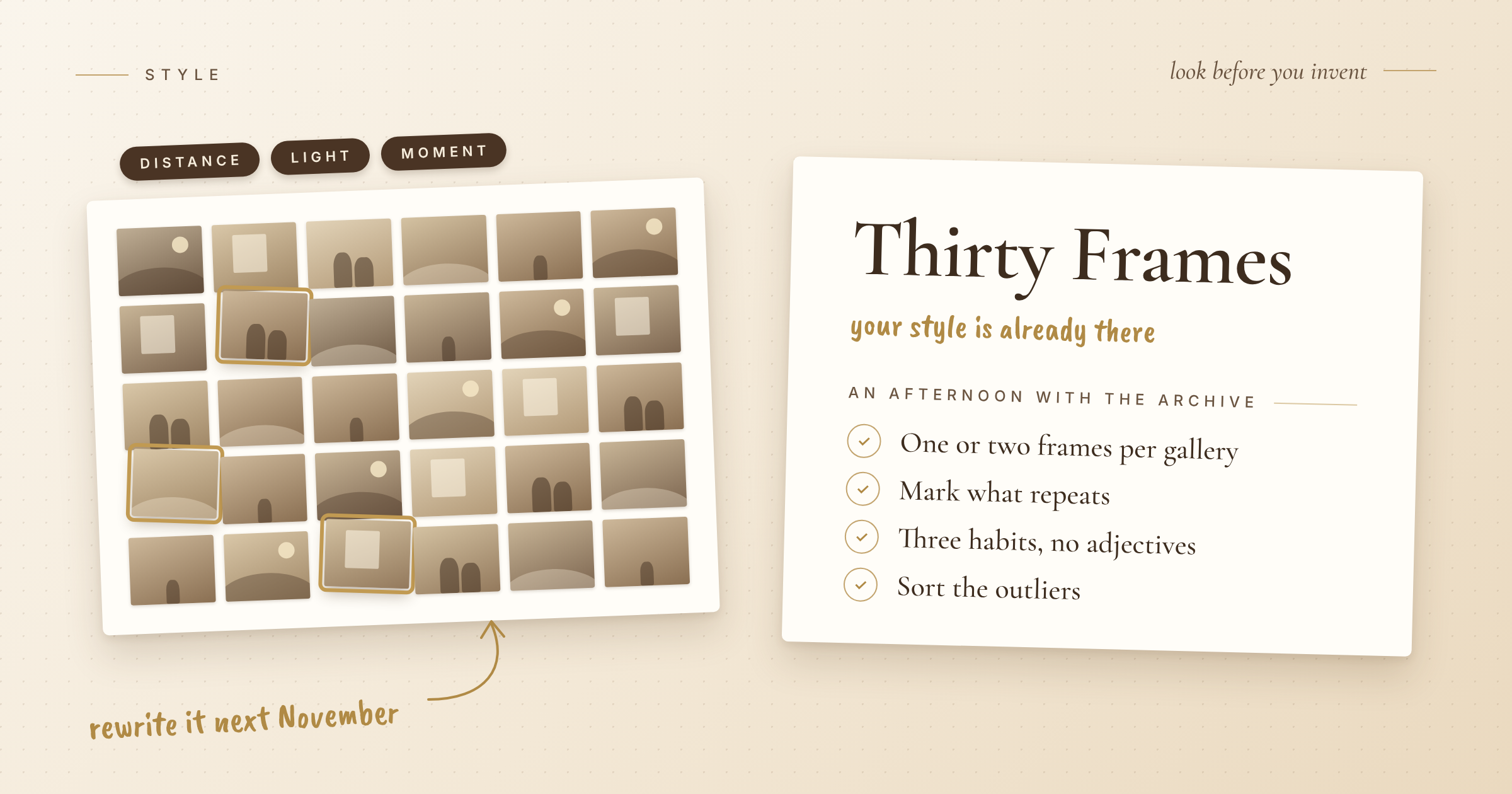
Pull thirty frames
Open each delivered gallery and take out one or two frames. Not the client's favourites and not the most technically perfect ones: the frames you would still show someone a year from now.
- Work from delivered galleries only. Outtakes and personal work tell you what you wish you shot. The galleries tell you what you actually shot.
- Set a number and keep it. Thirty is enough to show a pattern and small enough to lay out on one table or one screen.
- Go fast. Ten seconds per gallery for the first pick. If you start lingering, you start choosing what you think a portfolio should look like.
If a gallery gives you nothing, skip it and note which one it was. That is information too.
Lay them out and look for repeats
Print the thirty small, or put them on one screen at a size where you see all of them at once. Then stop looking at them as photographs and look at them as decisions.
- Distance. Do you stand back and let the room in, or go close until the background disappears?
- Light. Is it mostly from the side, from behind, flat? Do you chase the window or the shade?
- Where people sit in the frame. Centred, low in the frame, at the edge, small in a big space?
- The moment. The peak itself, or the second just before or after it?
- Colour. Warm, neutral, muted? Does it stay the same from a sunny garden to a dark hall?
Mark what repeats. Anything that shows up in two thirds of the frames is not an accident.
Name three habits in plain words
Now write down three sentences, each one a habit you can see on the table. Not adjectives - habits.
"Timeless" describes nothing. "I stand a step further back than most and leave space above people's heads" describes something a client can recognise and another photographer cannot copy by changing a preset. "When there is a choice, I put the light behind them." "I press after the laugh, not during it."
Three sentences like these are more useful than a mood board. They tell you what to protect next season when a client, a venue or a trend pulls the other way.
Look hard at the outliers
There will be four or five frames that do not fit. They are worth more attention than the thirty that do.
- Some are a direction. A frame you are proud of that does not look like the rest may be where the work is going. Keep it on the table and look for more like it next year.
- Some are a borrowed habit. A tilted horizon you saw everywhere in spring, a grade you copied for one job. If you would not choose it again, let it go.
- Some are a client's taste, not yours. That is not a failure. It is the job. Just do not put it in the portfolio and then wonder why you get booked for it.
The case against chasing a style
All of this can go wrong. A style named too early becomes a fence. Photographers who decide in their second year what their work looks like often stop noticing the frames that do not fit, and those frames were how they would have grown.
Clients also book for reliability more than for signature. A family wants to know their children will look like themselves, not like your last campaign. If the habits on the table get in the way of that, the habits are the problem.
So treat the three sentences as a description of this year, not a rule for the next one. Write new ones next November and compare.
Let it show where clients actually look
A description is only useful if the work around it agrees. Your site, the gallery cover, the first frames a client sees: they should all say the same three sentences.
Often the first thing a future client sees is not your portfolio but a friend's gallery forwarded on a phone. That makes every client gallery for delivering photos a page of your portfolio, and the opening frames carry your style further than any page on your site.
When a frame from the thirty belongs in the portfolio, ask before you use it:
Hi Anna,
I have been going through this year's work, and one frame from your wedding keeps stopping me: the two of you on the steps after the rain. I would love to show it on my website.
If you would rather keep it private, that is completely fine and nothing changes. Just reply either way.
An afternoon with the archive
- One or two frames from every delivered gallery, thirty in total
- Laid out together, small enough to see all at once
- Repeats marked: distance, light, placement, moment, colour
- Three habits written as plain sentences, no adjectives
- Outliers sorted: direction, borrowed habit, client's taste
- Portfolio and gallery covers checked against the three sentences
- Permission asked before any client frame goes public
- The sentences dated, to be rewritten next November
The thirty frames will not tell you who to be. They will tell you who you have been, which is a better place to start.