They open it on the sofa the evening it arrives, one phone between two people. The first frame is the dress on a hanger. Then the dress again, closer. Then the shoes, the rings, the invitation - eleven details before a single face. By frame forty they are scrolling with a thumb, waiting for the part with people in it.
Nothing in that gallery was a bad photograph. It was the right seventy frames in the wrong order. Shuffle the same files - one detail, then the mother doing up the buttons, then the shoes kicked off at midnight - and the same couple would have watched to the end and gone straight back to the top.
A gallery is read, not browsed
The first time anyone opens a gallery, they go through it once, in the order you chose. Later they will jump around and download favourites, but the first viewing decides how they feel about the work, and it happens in sequence.
You get no captions and no voice-over. The order is the only narration you have. However you set up the client gallery for delivering photos, that first scroll is the same: one person, one screen, one frame after another.
Open with the place, then the people
The cover is a poster, chosen to be seen on its own. The first frames inside are the opening sentence: where we are, who is here, what the day felt like.
- Start wide. One frame that shows the place - the house, the street, the room with the light coming in.
- Bring in a face early. By the third or fourth frame there should be a person. Details without people are a catalogue; people make it a story.
- Spread the details out. Rings and invitations work better as pauses between moments than as a block at the start.
Wide, medium, close - then wide again
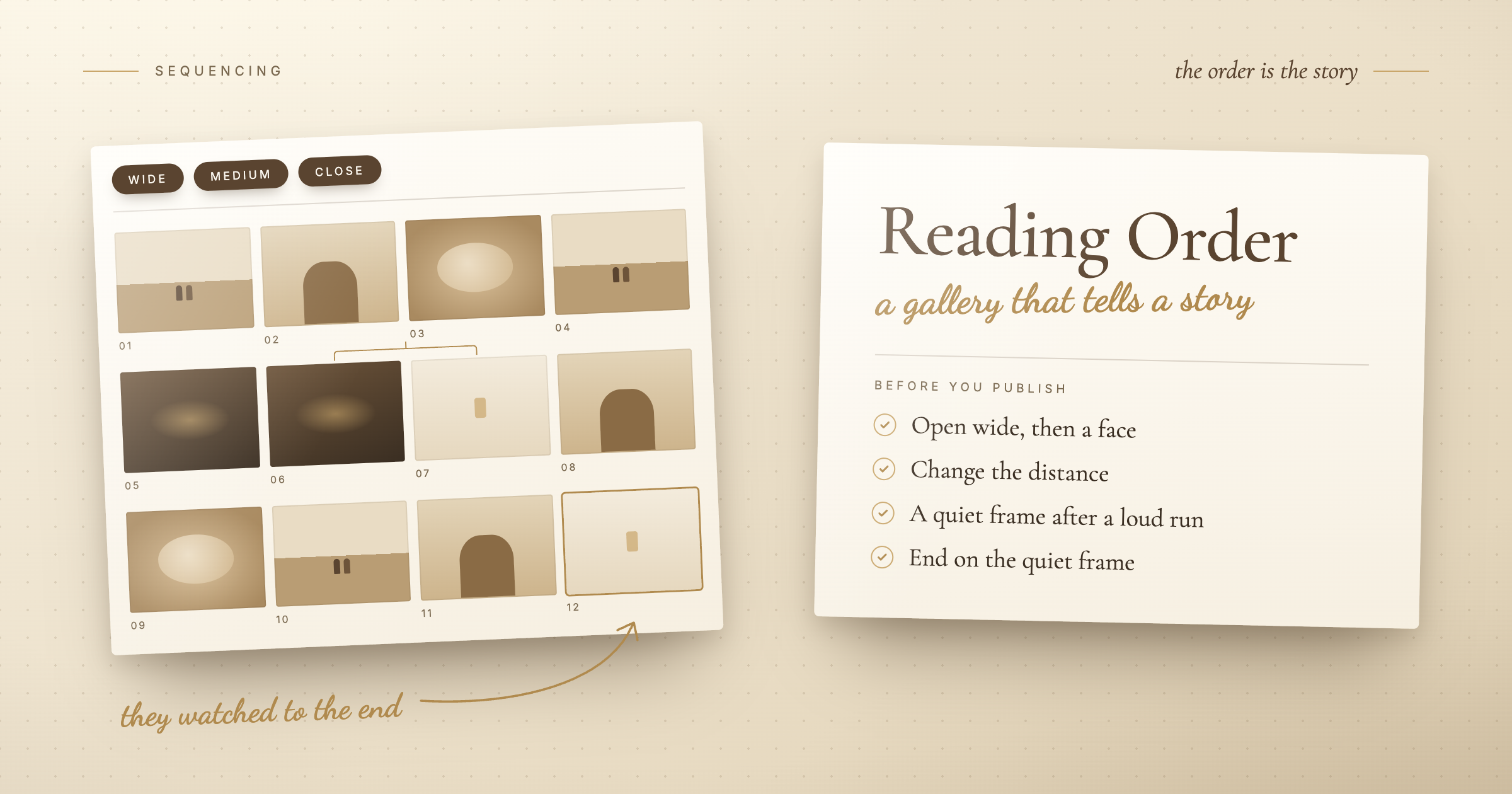
Film editors have worked this way for a century: a scene opens wide to show the space, moves in to the people, goes close for the thing that matters, then pulls back before the next scene.
A gallery reads the same way. Three close-ups in a row flatten into one; three wide frames in a row feel as if nobody is home. Change the distance and the eye keeps moving.
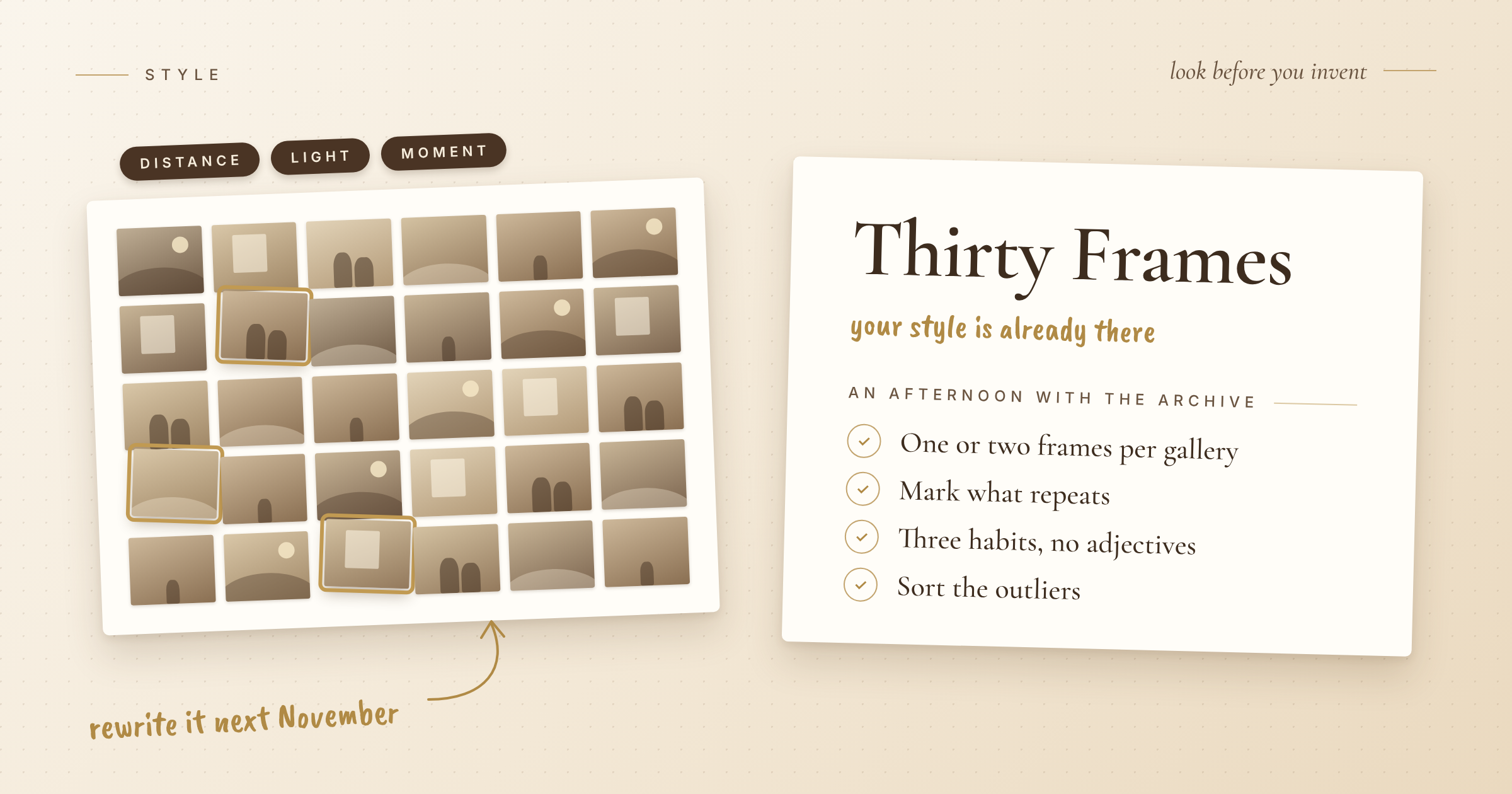
The quickest check is to zoom out to the thumbnail grid and squint. Runs of the same distance, the same tone or the same colour show up as blocks. Break the blocks.
Pairs say more than singles
Some frames are only half a sentence. The father reading his speech is one half; the daughter listening is the other. The hand on the shoulder before the first look, then the first look itself.
- Put the action before the reaction. Reversed, the reaction has nothing to react to.
- Check where the pair lands on a phone. Grids reflow, so a pair that sits side by side on a laptop can split across two rows on a phone.
- Do not pair everything. A gallery made only of pairs becomes a pattern. Keep it for moments that need their second half.
Change the tempo
A dance floor is twenty loud frames in a row: flash, sweat, arms in the air. Brilliant one at a time, exhausting as a run.
- Follow a loud run with one quiet frame. The empty chairs outside, a glass left on a windowsill, the shoes under a table. A rest in music is not silence; it is what makes the next bar land.
- Give your strongest frame some air. Put it after something calm, never inside a busy run where it competes with its neighbours.
- Use orientation as punctuation. After a string of verticals, one horizontal reads like a change of scene.
Time order is the spine, not the rule
Order by time by default. It is how the client remembers the day. But the spine allows small moves.
- Move a frame within its chapter, rarely across one. A detail from the ceremony can sit three frames later, where it rhymes with a gesture. Getting-ready frames cannot appear after the vows.
- Let details travel to where they rhyme. Rings photographed in the morning look better next to the hands at the ceremony than in a heap of morning details.
- Allow yourself one deliberate exception. A frame from the morning can close the day if it says something about the whole of it. One. Two is a puzzle.
The case for plain time order
Everything above assumes the gallery is a story. Often it is mostly an archive, and an archive should be easy to search.
A conference, a corporate party, a school day: nobody reads those for narrative. People want the photo of themselves or their team, and strict time order is the fastest way to find it.
Even at a wedding, some guests open the gallery for one frame - the family group with them in it - and close it again. Good sequencing should never make that harder. And an order that is too clever stops being the couple's day and becomes your edit. If someone asks why the cake comes before the speeches, the answer cannot be "rhythm".
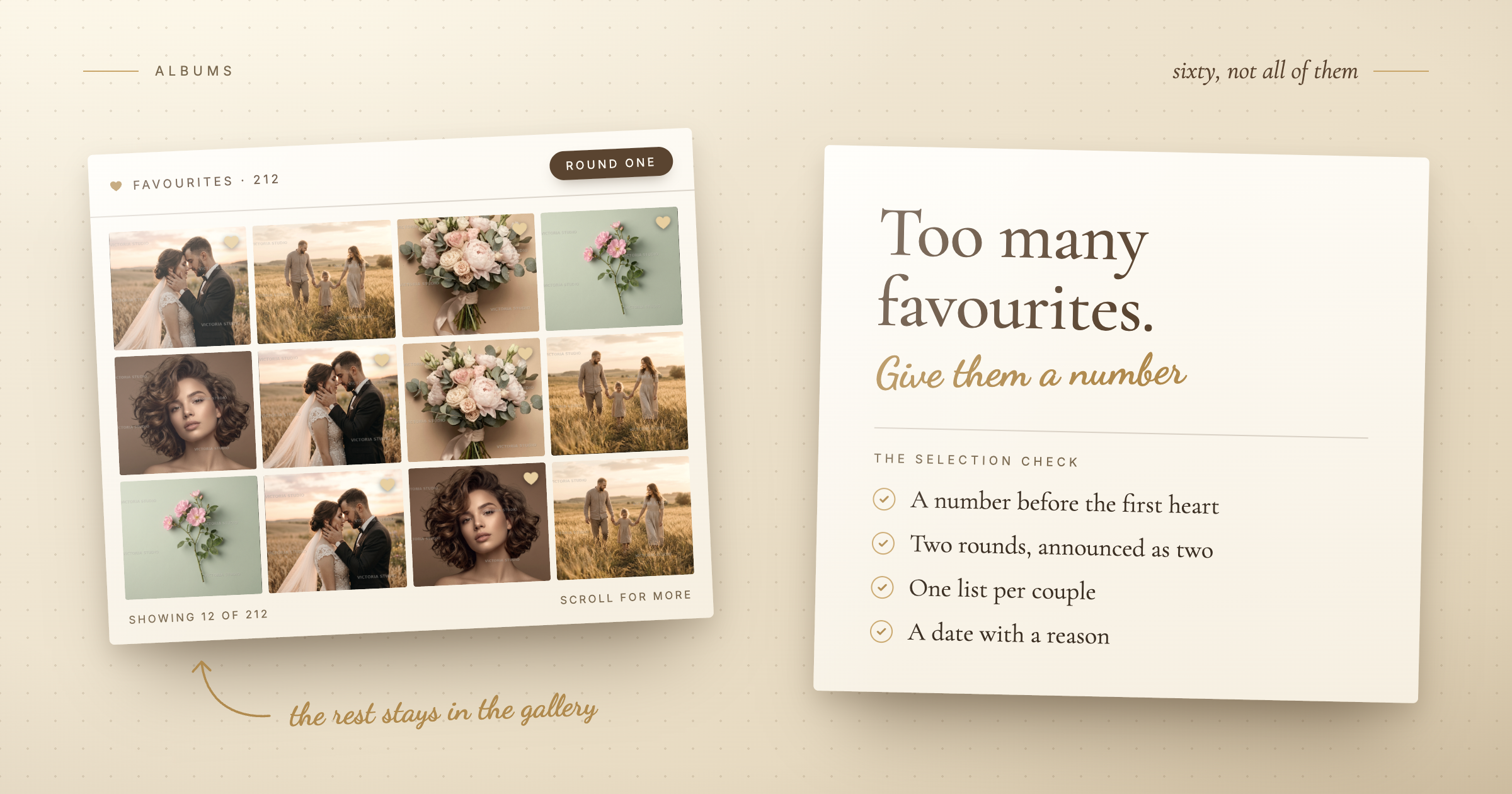
The working compromise is to sequence inside chapters and keep the chapters in time order: story for the people who scroll, findability for the people who search. Then say so in the handover message, so nobody has to fight the order:
Hi Anna,
The gallery follows your day in order, from the morning at your parents' house to the last dance. If anyone asks for the family group photos, they are in the ceremony part, about a third of the way down.
If you have a quiet half hour, watch it once from the top before you start choosing favourites. It was put together to be seen in that order.
End on the quiet frame
People remember how something ended better than most of what came before. The last frame is the one still on the screen when the phone goes down.
In strict time order, the last frame of a wedding is often the weakest: a blurry exit, one in the morning, someone's back. Do not end there. End on a frame with room in it - the couple walking away down the road, a child asleep in the car seat, the table after everyone has gone. A gallery that closes softly gets reopened.
Before you publish the order
- One wide opening frame, and a face within the first four
- Distances change; no run of three close-ups or three wide frames
- Pairs checked on a phone screen
- A quiet frame after every loud run
- The strongest frame placed after something calm
- Time order kept between chapters, moves only inside them
- Group photos easy to find for the people who only want those
- The last frame chosen, not inherited from the timeline
Clients will not notice the order. They will notice that they watched to the end.