Nearly every client opens with the same sentence: I'm so awkward in photos. They say it as a warning, sometimes as an apology. What they mean is that they have been photographed before, and they did not like what came back.
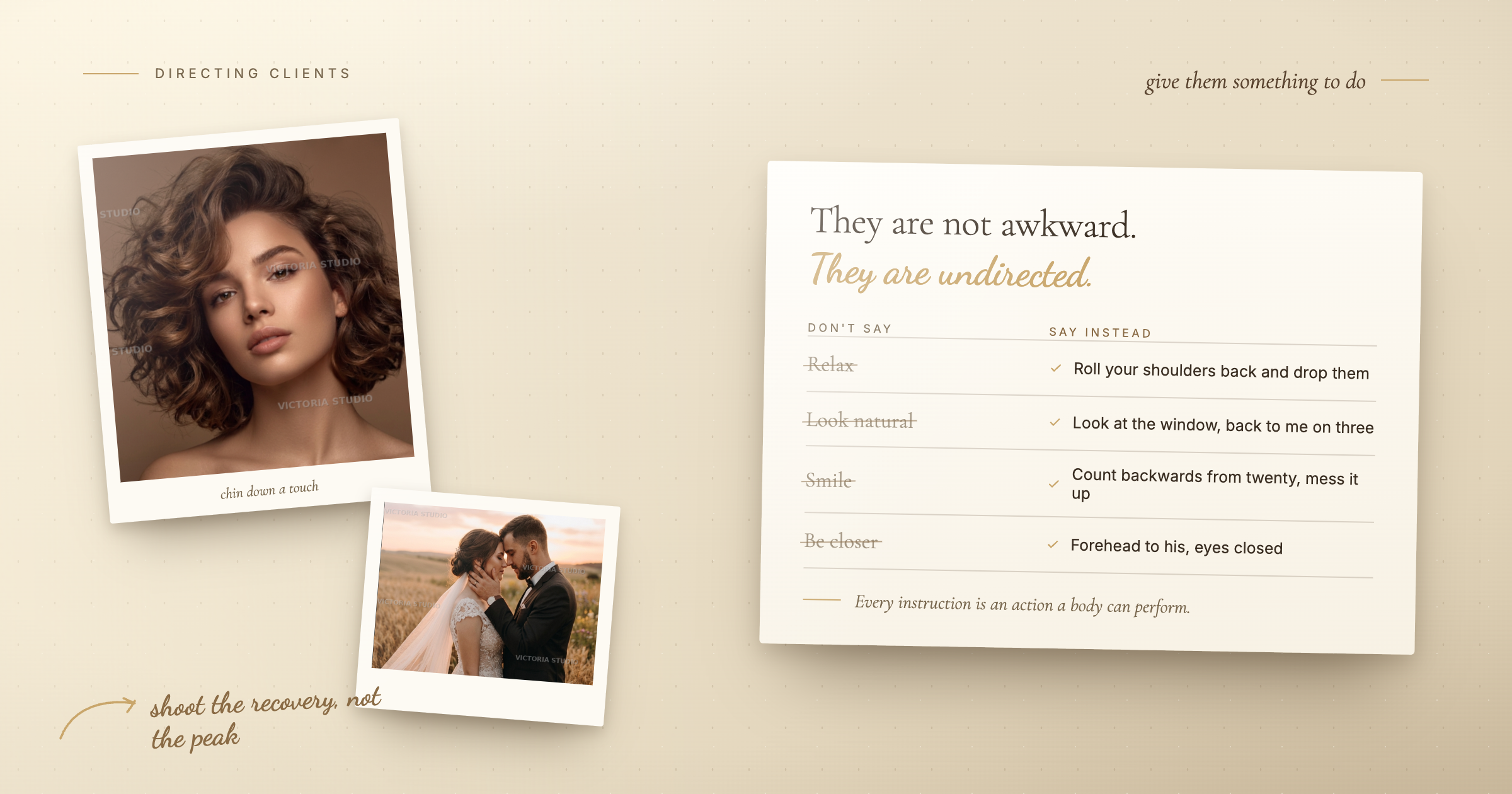
They are not bad subjects. They are undirected ones. A person standing in front of a lens with no instruction has nothing to do with their face, their hands or their weight, and the camera records exactly that vacancy. Your job in the first minutes is not to reassure them - it is to give them something to do.
The first five minutes decide the whole session
Do not start with a portrait. Start with something that has an obvious right answer and no emotional stakes.
- Photograph them walking. Toward you, away from you, along a wall - anything where the task is locomotion rather than expression. Walking has a rhythm they already know; nobody has to be told how to do it well.
- Show them one frame early. Not the whole back-of-camera slideshow - one image where they look good, held up for three seconds. It converts an abstract fear into visible evidence, and the shoulders drop.
- Talk about something other than the photos. Ask what they do, where they met, what they are doing afterwards. The answer matters less than the fact that they are speaking; a face that is mid-sentence is a face doing something.
- Do not comment on their nervousness. Naming it makes it real and makes it theirs to manage. Behave as though this is going normally, because it is.
"Relax" is the least useful word in the studio
Telling someone to relax asks them to change an internal state on command, which nobody can do. Worse, it informs them that they currently look tense - new information, and not welcome.
Replace states with actions. The instruction should be something a body can execute:
- Not "relax your shoulders" but "roll your shoulders back and drop them - yes, that."
- Not "look natural" but "look at the window, then back at me on three."
- Not "smile" but "press your tongue to the roof of your mouth" - it lifts the jawline - or simply say something that earns a real one.
- Not "be closer" but "put your forehead against his and close your eyes."
Every one of these has a verifiable result. The subject knows whether they did it. That certainty is what removes the anxiety - not encouragement.
Give the hands a job
Hands are where nervousness goes when the face is behaving. Left alone, they hang like something borrowed, or they clamp together in front of the body in the pose universally known as the fig leaf.
Give them contact and a small task:
- Touching their own body - hand to opposite elbow, thumb in a pocket with fingers out, fingers at the collar or in the hair
- Touching each other - one hand on a shoulder, fingers laced, a hand at the small of a back
- Holding an object that belongs to them: a coffee, a bouquet, a jacket over the arm, the dog's lead
Two details separate a real hand from a mannequin's. Keep them soft - a relaxed hand has slightly curved fingers and visible space between them; a tense one is flat and splayed. And turn the edge toward the lens rather than the back of the hand, which reads smaller and more elegant.
Movement beats stillness
A held pose decays. Ask someone to stand still and smile, and by frame four the smile has hardened into a grimace, because holding an expression is a muscular effort.
Build loops instead - small repeatable actions you can shoot through:
- Walk five steps toward me, stop, look at each other, walk back. Repeat.
- Whisper something to her, then let her react.
- Spin once, slowly, and let the dress settle.
- Hug, and then pull back just far enough to see each other's faces.
Shoot the recovery, not the peak. The frame you want is almost never the laugh itself - it is the second afterwards, when the face is still soft and the eyes have come back to the other person.
Two prompts that outperform everything else
- "Tell me about the day you met." Directed at one person while the other listens. The listener's face is the photograph; nobody can hold up a wall while hearing that story.
- "Count backwards from twenty, out loud, and mess it up on purpose." It is absurd, it is impossible to perform, and it reliably produces the unguarded laugh that no instruction to smile ever will.
Use them once each, at the moment the session flattens out.
When someone is genuinely uncomfortable
There is a difference between nervous and unwilling. If someone is holding their arms across their body, giving one-word answers and looking at the exit, more direction will not help - it will confirm that they were right to dread this.
Change the geometry instead:
- Increase your distance. Switch to a longer lens and step back. Presence is more intimidating than a camera; take yourself out of their personal space.
- Turn them away from the lens - looking out of a window, at their partner, at their child. Faces that are not aimed at the camera stop performing.
- Put the camera down for a minute. Nothing costs less and nothing buys more.
- Photograph them with someone they love. People who cannot be alone in front of a lens are often completely at ease the moment they have someone to look at.
What to say when they ask "what do I do with my face?"
Answer with a task, always. "Look at me, chin down a touch, now think about the fact that we're nearly done." Give them a target for their eyes, one adjustment for the head, and one thought.
If you take only one thing from this: your clients are not asking to be reassured. They are asking to be told what to do by someone who clearly knows. Certainty in your voice does more for their face than any compliment.
A pocket checklist
- Open with movement, not a portrait
- Show one good frame in the first five minutes
- Never say relax, look natural, or just be yourself
- Every instruction is an action a body can perform
- Hands: contact, a soft shape, edge to the lens
- Build repeatable loops and shoot the recovery frame
- If someone shuts down, add distance and turn them away from the lens