The forecast has said rain for three days, and on the morning of the wedding it is right. At eight the couple sends a message: an umbrella and the words "what do we do?". The planner is moving chairs under the marquee. Everyone looks at you as if you could order the weather.
You can't, but you can stop treating it as the enemy. Rain changes the light, the colours and the way people stand next to each other, and some of the best pictures of a year come from the days nobody wanted. It takes a plan, a few habits with the camera and, sometimes, the honesty to go inside.
Rain is light, not just weather
- Cloud is the largest softbox you will ever work under. No hard shadows under the eyes, no squinting, no hunt for shade at noon. Skin is even, and you can turn people any way you like.
- Wet surfaces saturate. Leaves, stone and cobbles go darker and richer. Colours that look flat in sunshine suddenly hold together.
- People come closer. Under one umbrella, in a doorway, under a jacket held over two heads, couples stand the way you spend sunny days asking them to stand.
What you lose is brightness. Expect a higher ISO and a wider aperture than on a clear day, and decide in advance that a little grain is fine.
The message to send the week before
A rain plan works best when it is not news on the day. As soon as the forecast starts to wobble, send a short note that turns the worry into a plan.
Hi Anna,
I've seen the forecast for Saturday too. Rain changes less than you think, and it often brings the softest light of the year.
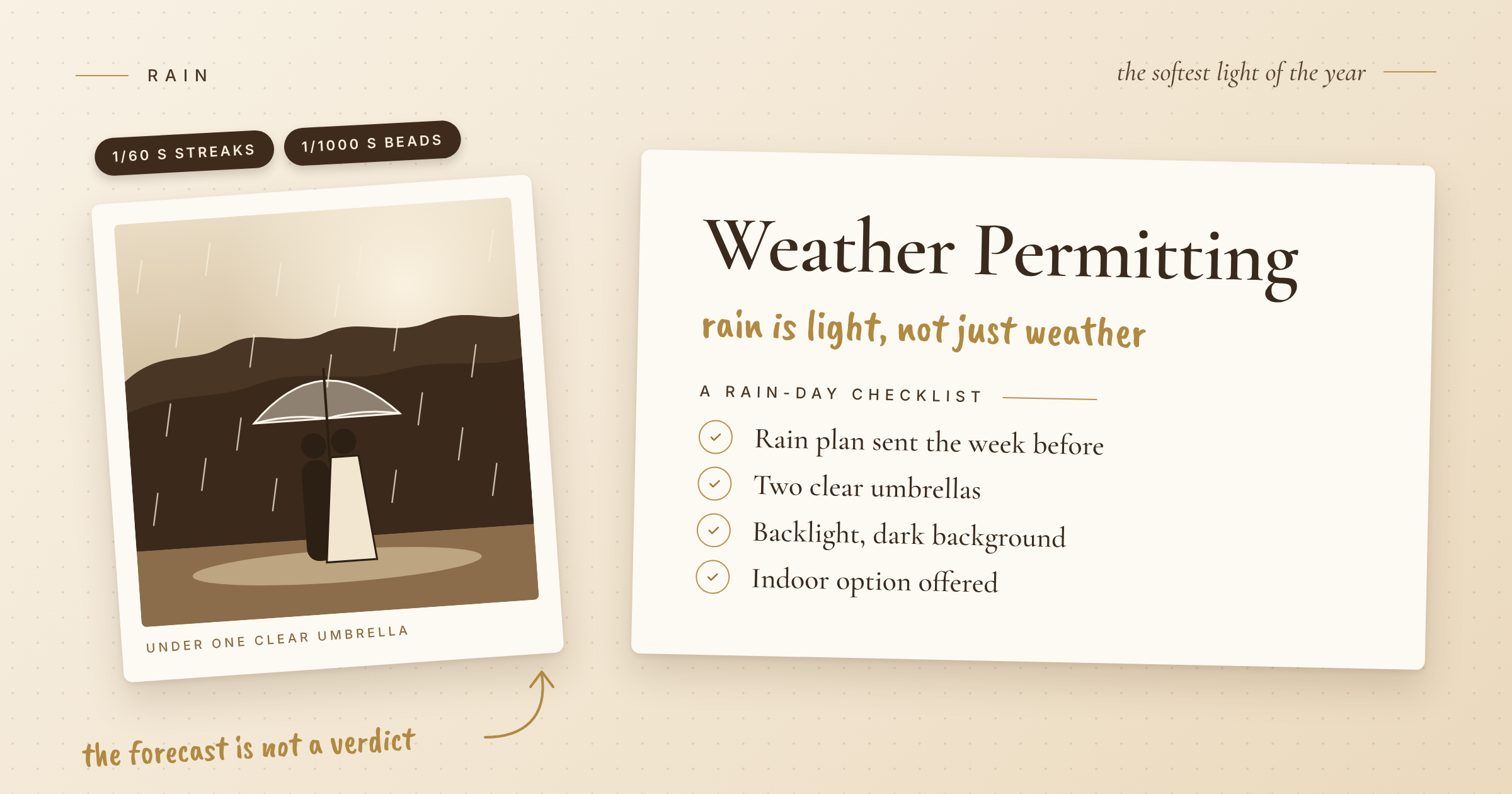
If it rains, we'll do the portraits close to the venue: the covered porch, the old barn door and, if you're up for it, ten minutes outside under clear umbrellas. I'll bring two. If it pours, we'll stay in and use the big windows in the hall.
The only thing I'd ask: shoes you don't mind getting wet for the outdoor part, and a towel in the car.
Keep it calm and specific. A couple who know there is a plan stop checking the forecast every hour.
Making the rain show up in the picture
Rain is surprisingly hard to see in a photograph. In flat light against a pale sky it simply disappears.
- Light it from behind. Drops become visible when light comes through them towards the lens: a lamp, a lit window, a car's headlights, a bright patch of sky low behind the couple.
- Put something dark behind it. A hedge, an open barn, a line of trees. Backlit drops against a dark background read clearly; against a white sky they are gone.
- Choose streaks or beads. A large raindrop falls at roughly nine metres per second. At 1/60 s it travels about 15 centimetres while the shutter is open and draws a line; at 1/1000 s it moves about 9 millimetres and stays a bead. Neither is right, they tell different stories.
- Reach for a longer lens. Compression stacks the drops between you and the couple, so a light drizzle reads as rain.
Umbrellas, doorways and cover
- Clear umbrellas are worth carrying. They keep faces lit and visible. A black umbrella turns two faces into one shadow, a coloured one tints the skin.
- Use the edge of cover. Stand the couple just inside a doorway, a porch or an archway, facing out. They stay dry, the light on their faces comes from the open sky, and the rain falls in the frame between you.
- Let the umbrella be the subject. From above, from behind, from far away across a field: one umbrella in a wide grey landscape is often the picture of the day.
- Arrange your own cover. A second shooter or a guest holding an umbrella over you frees both hands. Failing that, a hood on the lens and you under the eaves.
Puddles and reflections
After the heaviest shower the ground does the work.
- Get the lens close to the water. A puddle the size of a tray, shot from a few centimetres above, becomes a mirror for a whole building and two people.
- Wait for it to settle. Falling drops break the reflection into rings; between showers it goes still.
- Flip it if you like. A reflection turned upside down in the edit is an old trick, but it still surprises people.
Keeping the gear alive
- Cover first, then shoot. A rain cover, or even a plastic bag with a hole for the lens, and the lens hood on all day: it keeps most drops off the front element.
- A microfibre cloth in every pocket. One drop on the front of the lens softens a whole series, and the small screen will not show it. Check at full magnification between scenes.
- Change cards and lenses under cover. Never in the open, never with wet hands.
- Mind the condensation. Walking from a cold, wet garden into a warm hall fogs the lens, inside and out. Put the camera in a closed bag before you go in and let it warm up slowly.
- Dry everything that evening. Open the battery and card doors, take off the cover, let the bag air out overnight.
The case for going inside
Not every rainy day is a gift, and pretending otherwise is unkind.
Cold rain in November is not romantic for a bride in a thin dress or for grandparents waiting in a car park. Make-up that took an hour can be gone in five minutes. Some couples simply do not want wet hems and muddy shoes in their pictures, and that is a reasonable thing to want.
Offer the ten minutes outside, never push for them. A warm portrait by a big window is better than a soaked couple who hated every second of it, and they will remember how the day felt long after they have forgotten the light. The message above includes "we'll stay in" for a reason.
When the gallery goes out
Rainy days tend to produce a gallery with its own mood: softer, darker, closer. Show it on its own terms.
- Keep the rain together. A run of umbrella frames reads as a chapter. Scattered between indoor pictures, it looks like an accident.
- Do not grade the weather away. Brightening a grey day until it pretends to be sunny makes skin look strange and the whole day look fake.
- Say it in the handover. One line in the email that comes with the client gallery for delivering photos, something like "the rain gave us some of my favourite frames of the year", tells them how to read it before they start scrolling.
A rain-day checklist
- The rain plan sent to the couple the week before
- Two clear umbrellas and a towel in the car
- Covered spots near the venue picked in advance
- Backlight and a dark background, so the rain shows
- Shutter speed chosen on purpose: streaks or beads
- Rain cover, lens hood and microfibre cloths
- A closed bag for the walk from cold to warm
- The indoor option offered, never argued against
The forecast is not a verdict on the day. It is one more thing about the light, and reading light is already your job.