It is late November. The season is over, the drive holds eleven weddings that are not finished yet, and on Monday morning an email arrives: "Hi, just wondering how our photos are coming along?" It is polite. It is also the third one this month, and each of them was written because nobody knew when to expect anything.
Clients rarely remember how fast a gallery arrived. They remember whether it arrived when you said it would. A date you keep makes six weeks feel fine; a date you miss makes four weeks feel long. The craft here is not editing faster. It is promising the right date and then keeping it.
The date matters more than the speed
- A kept promise is calm. The couple knows when to look, stops checking their inbox and does not need to write to you.
- A missed promise is noise. One late gallery brings a reminder, an apology, a second reminder and a review that mentions the wait before the photos.
- Fast is a bonus, not a contract. Delivering a week early is a pleasant surprise. Promising early and then slipping undoes it.
Count the queue, not the wedding
The usual mistake is to think about the one wedding in front of you: "about two weeks of work". But the gallery does not start the day after the wedding. It waits behind the ones you have not finished.
Time one ordinary wedding from import to finished gallery, with a timer, including the culling, the edit, the last look and the upload. Then do the sum on the Monday after each wedding:
- Hours already in the queue. Say four galleries are ahead, at fourteen hours each: 56 hours.
- Plus this one. Another fourteen hours: 70 in total.
- Divided by the hours you really edit. Not the hours you work, but the hours left for editing after shoots, meetings and emails. At twelve a week, 70 hours is just under six weeks.
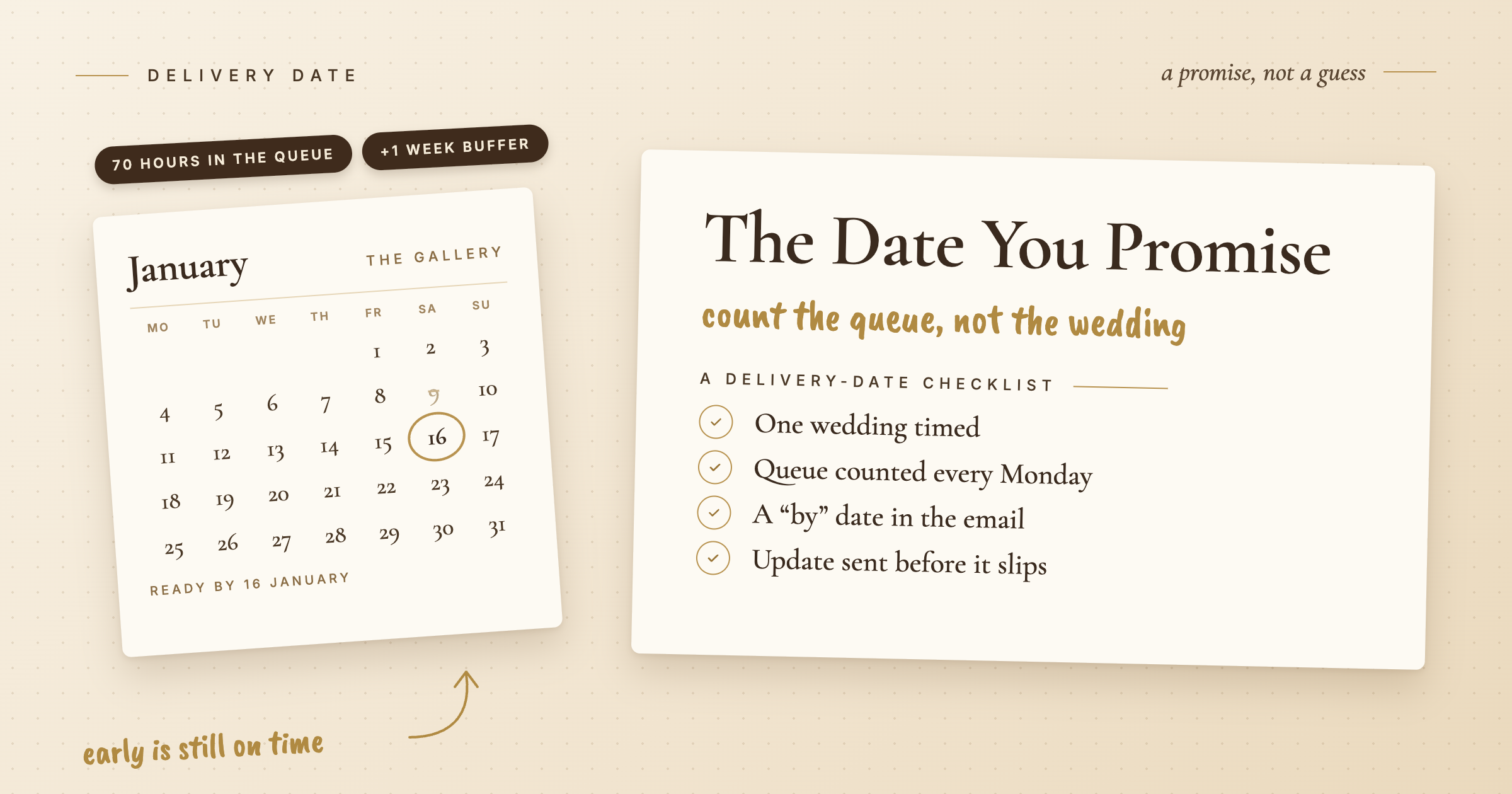
- Plus a buffer. A week for a cold, a broken laptop or a gallery that needs more than usual. The honest promise is seven weeks.
If your price list says four weeks and the sum says seven, the price list is the thing to change.
Turn weeks into a date
"Seven weeks" is something the client has to work out; "by 9 January" is something they can put in a calendar. Give a date, and give it as "by", so delivering early is still keeping your word.
- Look at the calendar the weeks cross. A wedding on 21 November plus seven weeks lands on 9 January, straight across Christmas. If you do not edit between the holidays, add that week: 16 January.
- Say when the clock starts. For most shoots it is the day after. For a session where the client chooses the frames first, it starts when they have chosen.
- Write the range in the contract, the date in the email. The contract can say "six to eight weeks". The email after the wedding names the exact day, because only then do you know your queue.
When the client's choice is part of the timeline
Some deliveries cannot be dated from the shoot at all. If the client picks which frames you retouch, or which go into an album, your part starts when their part ends, and a choice that takes three weeks quietly moves your date by three weeks.
Make that visible from the start. Agree a deadline for the choice, say how many working days the retouching takes after it, and make choosing easy: letting clients choose photos online, with favourites marked in one place, is faster than a list of file numbers sent back by email. If the choice arrives late, the date moves by the same number of days, and the client already knows why.
If you are going to miss it
Sometimes the date will not hold. Illness, a family emergency, a drive that dies. What matters then is when the client hears about it.
- Write before the date, not after. A week before is an update. The day after is an apology.
- Give a new date, not a vague "soon". And make it one you are sure of.
- Give a reason in one sentence. No long story, no list of everything else you have to do.
Hi Anna,
A short update about your gallery. I promised it by 16 January, and I need one more week: it will be ready by 23 January.
I was ill for most of last week and I would rather finish your edit properly than hurry the evening part of the day. The ceremony and the portraits are already done.
Thank you for your patience, and I will send the link as soon as it is ready.
One message like this, sent early, costs less goodwill than a single reminder from the client.
The case for a range instead of a date
Some photographers never name a day, and their reasons deserve a hearing. A range like "six to eight weeks" protects them from the weeks that go wrong. A fixed date puts pressure on the edit, and pressure tends to show in the last gallery of a long queue. A few work in a way that does not fit a schedule at all, and their clients book them knowing that.
The weak spot of a range is that clients tend to remember its first number. "Six to eight weeks" is read as six, and the reminders start in week seven. If you keep a range, keep it short and confirm the real date once the queue is clear. A date confirmed late is still better than one guessed early.
A delivery-date checklist
- One ordinary wedding timed, from import to upload
- Weekly editing hours counted honestly
- The queue counted on the Monday after every wedding
- A week of buffer added, and the holidays the date crosses
- A range in the contract, an exact "by" date in the email
- A deadline for the client's choice, where there is one
- A message ready for the week before a date that will slip
Nobody books a photographer for the turnaround. But a date that arrives as promised is the last thing a client experiences before they open the photos, and it colours the first look.