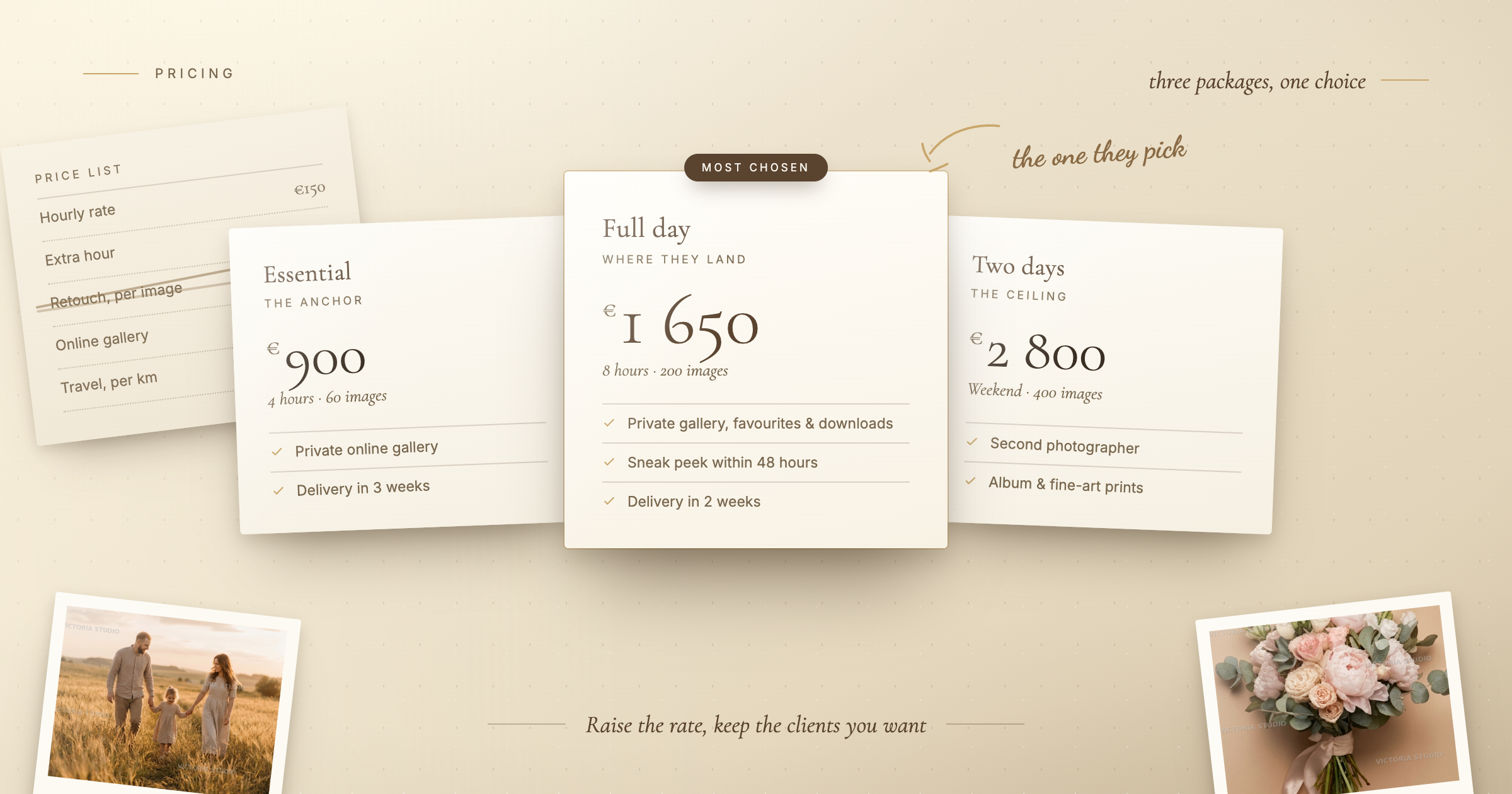
Most photographers price by listing what they own: hours, edited images, travel, an album, maybe a second shooter. It reads like a hardware invoice. The client opens it, sees eleven line items and three optional extras, and does the one thing you never wanted them to do - arithmetic.
A price list asks how much does this cost? Three packages ask which one am I? The second question is far easier to answer, and the answer is almost never the cheapest one.
Why three, and not five
Three is the smallest number that creates a comparison. One price is a demand. Two feels like cheap versus expensive. Five is a spreadsheet.
- Package one is the anchor, not the goal. It exists so the middle one looks reasonable. It should be genuinely usable - never crippled - but visibly narrower in scope.
- Package two is what you actually want to sell. Price it where your business works at a comfortable volume, then load it so it is obviously the best value per euro.
- Package three is for the client who wants everything. Some clients buy the top tier purely because it is the top tier. Do not omit it because you think nobody will take it; the people who do are your best-paying clients.
A useful spacing is roughly 1 : 1.6 : 2.4. If your middle package is €900, the anchor sits near €550 and the top near €2,100. Tighter than that and the middle stops looking like a bargain; wider and the top tier reads as a different business.
What belongs in the base package
The base tier is where photographers make their most expensive mistake: they strip it until it is unbuyable, hoping to force an upgrade. What actually happens is that the client concludes you are expensive and leaves.
Include everything required for the work to be finished:
- Enough coverage to tell the story - for a wedding that is rarely under six hours
- A number of edited images you can state in writing
- An online gallery the client can download in full, at full resolution
- Personal-use licence, spelled out in plain language
Then put the genuinely optional things above it: extra hours, a second shooter, an album, a pre-wedding session, prints, a same-day teaser edit. Upgrades should feel like additions to a complete thing, not repairs to a broken one.
Price the year, not the shoot
Photographers underprice because they quote against the day and forget the calendar. Work backwards instead.
- Fix your target income. Say €36,000 a year from photography, after costs.
- Add the real costs: gear depreciation, insurance, software, storage and gallery hosting, travel, accounting, marketing. Say €9,000. You now need €45,000 in revenue.
- Decide how many shoots you can deliver well. Not how many you could book - how many you can shoot, cull, edit and hand over without your quality sliding. Twenty-five weddings is a full, hard year for one person.
- Divide. €45,000 ÷ 25 = €1,800 average per booking. If your middle package is €900, the arithmetic has already told you something: either the price doubles or you need fifty weddings, which you cannot deliver.
This is also the calculation that tells you when to stop discounting. Fifteen percent off looks like a small gesture on a single booking. Grant it habitually and you have removed 15% of the year: at a €1,800 average that is €6,750, or nearly four extra weddings you now have to find, shoot and edit to end up where you planned. The ratio holds whatever your prices are - a 15% habit always costs you 3.75 bookings out of every 25.
Never quote a single number in an email
The number in isolation always looks large, because there is nothing beside it. Send the three packages as a small document or a page, in the same order every time, with the middle one visually emphasised.
Three practical details that consistently move the decision:
- Put the price under the description, not above it. People should read what they get before they read what it costs.
- Use words, not tables, for the differences. "Full day, from getting ready to the first dances" lands harder than "10 h".
- Give the packages plain names. "Half day", "Full day", "Full day plus album" - never Bronze, Silver, Gold. Metals ask the client to rank themselves, and nobody wants to be bronze.
How to raise your prices
Raise them on the next enquiry, not for the people already booked. That is the whole trick, and it removes almost all of the fear.
- Move in steps of 10–20%. Small enough that the market absorbs it, large enough to matter to your year.
- Raise when you are turning work away, or when your calendar for the season fills more than six months out. Both are the market telling you the price is too low.
- Change something visible at the same time - a new album supplier, a faster delivery promise, a nicer gallery experience. The increase then attaches to a reason rather than to a mood.
- Let the old price go quietly. No announcement, no apology, no "prices going up soon" campaign. Just a new document.
Expect to lose some enquiries. That is the mechanism working, not failing: you are trading the clients who chose you on price for the ones who chose you on work.
The uncomfortable part
Your pricing is a filter, and it filters in both directions. Priced low, you attract clients who compare you to other cheap options and negotiate hardest - the same clients who will ask for the RAWs and query the delivery date. Priced at what the work is worth, you attract fewer enquiries and better ones, and you get your evenings back.
The number itself matters less than whether you can say it without flinching. Rebuild the three packages, run the annual arithmetic, and quote the middle one first.
A checklist before you send the next quote
- Three packages, plain names, same order every time
- Base tier is complete and buyable on its own
- Middle tier is the best value and visually emphasised
- Spacing roughly 1 : 1.6 : 2.4
- Price sits below the description, not above it
- Annual arithmetic checked: average booking value × realistic volume covers income plus costs
- Extras listed as additions, not as fixes