Look at any set you delivered a year ago and try to remember which frames you were proud of at the time. Then look at which ones the client actually used - as a profile picture, in a frame on a shelf, in the message they sent their friends.
The overlap is smaller than it should be. The one they chose is often a frame you nearly deleted: slightly soft, cropped oddly, someone half-turned. It survived because something is happening in it that is not happening in the others.
What is actually in those frames
A posed photograph shows what someone looks like. An in-between frame shows what they are like - which is a different subject entirely, and the one people recognise themselves in.
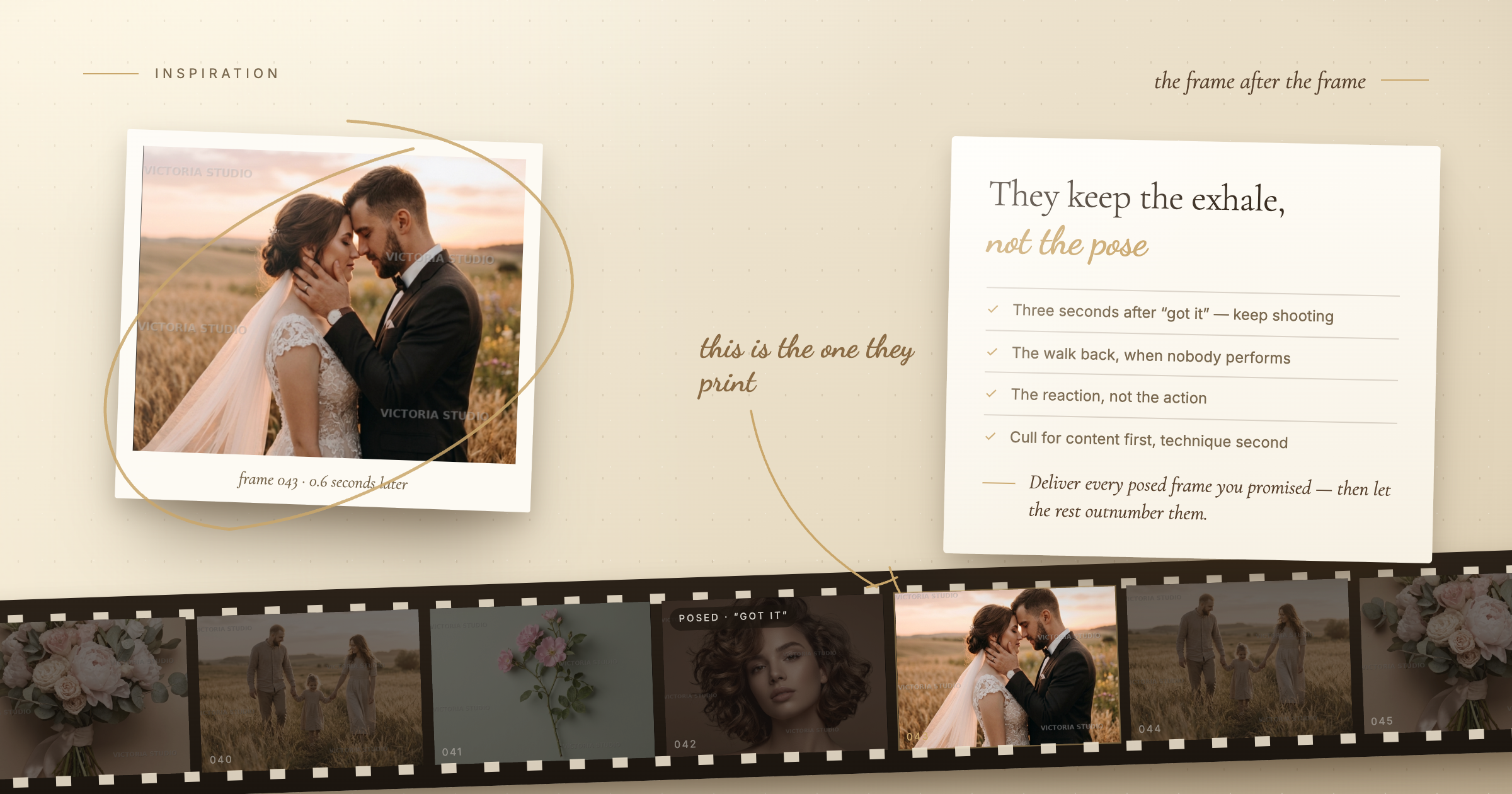
The mechanism is simple and slightly unflattering to us: for the two seconds after you say "got it", the subject stops performing. The face they were holding drops. What replaces it is not a better expression, it is a real one - and a real expression at 90% technical quality beats a held one at 100% every time, because the client is not grading your focus.
Learn the beats - they repeat
The unposed moments feel random. They are not. Across weddings, families and portraits, the same handful of beats recur, and once you know them you can be standing in the right place before they arrive.
- The three seconds after "got it". The single most reliable one. Say it, do not lower the camera, keep shooting.
- The walk back. You send them somewhere, photograph the pose, then they return towards you. Nobody is performing on the way back.
- The reaction, not the action. When one person speaks, the photograph is usually the other person's face. Same at a ceremony: turn away from the couple and look at the front row.
- Hands finding each other. Between instructions, people touch - a hand on a back, a thumb on a knuckle, a sleeve straightened. Nobody has ever posed for that and it reads instantly.
- The moment they check on each other. Right after something awkward, partners look at one another to see if it was all right. That glance is a whole relationship in one frame.
- Getting ready and packing up. The first ten minutes and the last five, when the day is not officially "the photos" yet.
Position for it before it happens
You cannot chase these; by the time you have moved, the moment is gone. What you can do is set yourself up so that when it arrives you are already right.
Stand where the light is, not where the moment is. Choose your position for the background and the direction of the light, then let people move into it. A beautiful gesture in ugly light is a frame you will not keep.
Keep the camera up. Chimping after every burst - checking the screen - is how you miss the two seconds that matter. Look at the back of the camera between setups, not between frames.
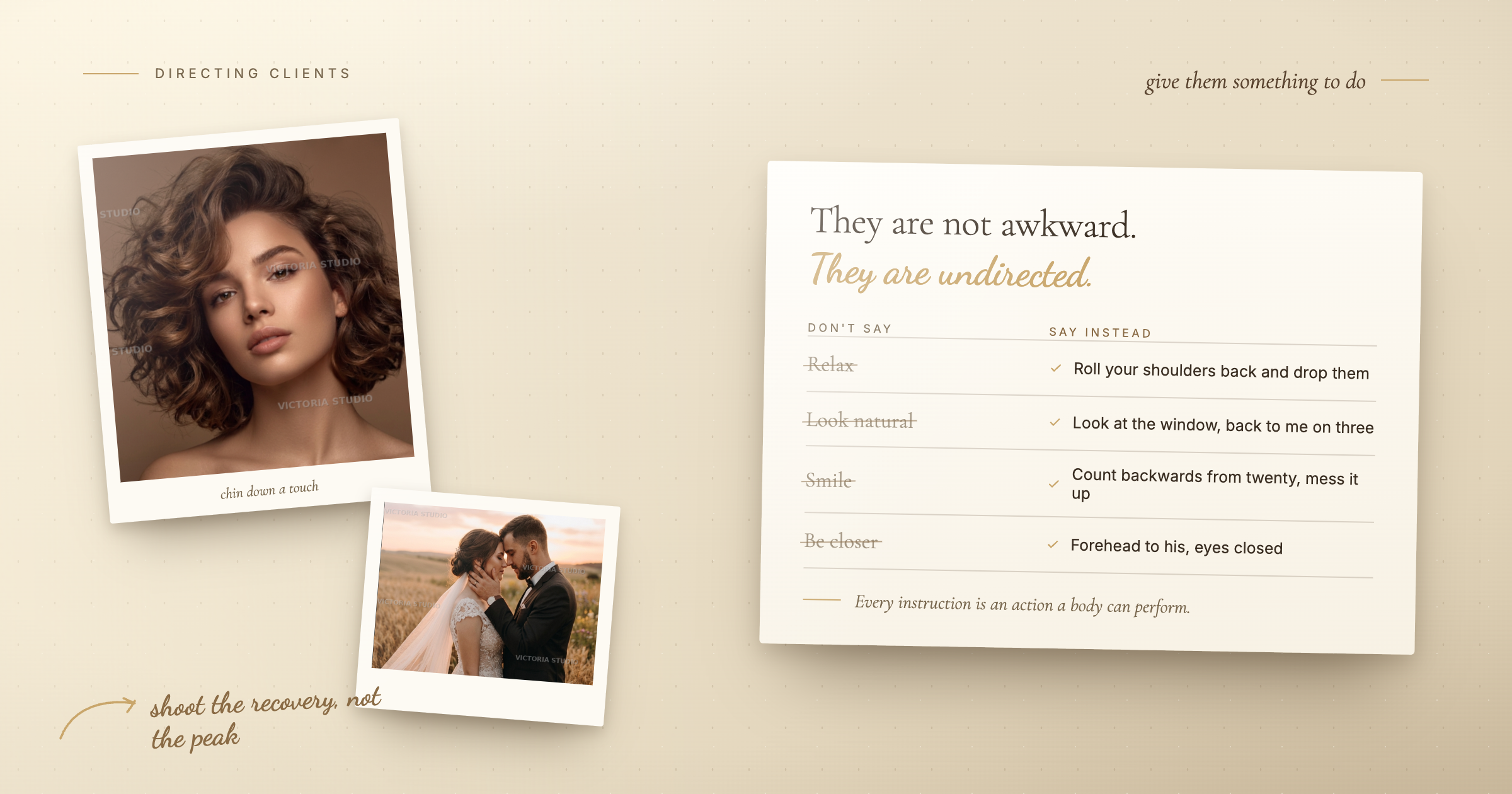
Stop announcing the end. "Got it" and "perfect, thanks" are instructions to stop being interesting. Say nothing, or say it and keep the shutter going anyway.
Shoot wider than feels right. A frame with room around it survives a crop later; a tight frame around a moment you did not expect usually clips an elbow and dies.
Get closer than feels polite, earlier than feels natural. Not for the frame - for the habituation. If you have been near them for twenty minutes, your presence at the moment they forget you is not an event.
The part most articles skip
There is a romance around candid photography that does not survive contact with a delivered gallery. A set made only of in-between frames is exhausting to look at, and clients are quietly disappointed by it even when they cannot say why.
They need the posed frames. The one where everyone is looking at the camera and nobody is blinking is the one that goes to grandparents, gets printed, sits on the shelf. It is not the interesting photograph, but it is the necessary one, and the whole family will notice if it is missing.
The two are not in competition. Posed frames are what create the in-between moments in the first place: the instruction, the effort, the small failure, the laugh at the small failure. Take away the structure and there is nothing to fall out of.
A working ratio, if you want one: deliver every posed frame you promised, then let the unposed ones outnumber them two to one in the sequence.
Do not lose them in the edit
The in-between frames are the ones most likely to die during culling, because they fail the checks a technical pass applies - sharpness, symmetry, everyone looking, clean edges.
- Cull for content before you cull for technique. First pass keeps anything where something is happening, regardless of quality. Judge sharpness afterwards, and only against frames that survived.
- Do not put them all together. A run of six candids reads as filler. Alternate: the set-up, then what fell out of it. Rhythm is the argument.
- Keep the flawed one if the flaw is not the subject. Slight motion blur on a hand is fine. Soft eyes are not. That is the whole rule.
The thing worth remembering
You are not being paid to produce evidence that these people were in a room together. Anyone with a phone can do that, and they already have five hundred of them.
You are being paid for the frames they cannot take themselves - which are almost never the ones they asked you for.