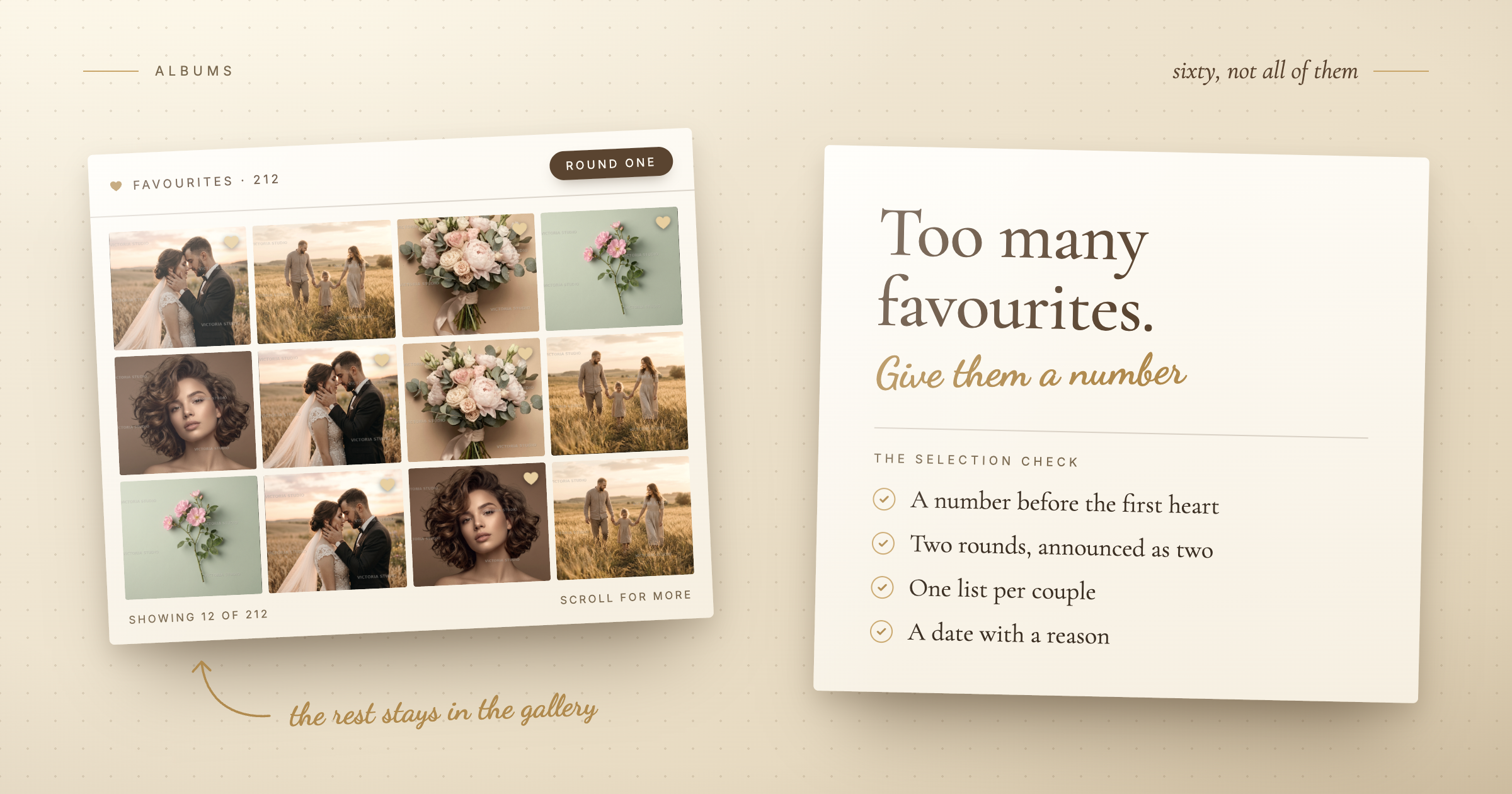
The gallery went out in May. It is now October, the album has not been ordered, and the favourites list has two hundred and twelve hearts on it. Nobody is upset. Nobody has said no. The selection has simply stopped, somewhere between "we love them all" and a free weekend that has not arrived yet.
This is one of the most common ways album work quietly dies, and it rarely has anything to do with the photographs. A selection stalls because of how it was asked for. Change the question and most couples finish in a couple of evenings.
Why an open choice stalls
"Pick your favourites" sounds generous. In practice it hands the client three problems at once.
- There is no finish line. Without a number, every frame they like is a candidate, and a list with no target never feels done.
- Leaving a photo out feels like losing it. Many clients quietly assume the photos they do not pick are gone, so every cut feels like a small loss.
- Two people, two lists. A couple choosing separately produces two long lists that overlap by half, and merging them is a conversation nobody wants to start.
None of this is indecision. It is a task with no edges, and people postpone tasks with no edges.
Say the number before they open the gallery
The most useful sentence in the whole process is the one that tells them how many.
- Give a target, not a limit. "The album has room for about sixty photos" is a shape to fill. "Maximum sixty" is a rule to break.
- Say it in the same message that sends the gallery, before the first heart, not after they have marked two hundred. A number that arrives late reads as a correction.
- Say what happens to everything else. The photos they do not choose stay in their gallery and are still theirs to download. They are choosing a layout, not deciding what they keep. That one line removes more hesitation than anything else you can write.
Two rounds, announced as two
Choosing sixty from six hundred in one pass is hard. Choosing loosely, then narrowing, is not.
Round one is generous. Heart everything you would be sad not to see in the album, no limit, ideally in one sitting. This is what a client proofing gallery is for: the marking happens where the photos are, and you read the result instead of a list of file names.
Round two is the edit. When round one is done, tell them the count and ask them to bring it down to the target. Narrowing a shortlist of a hundred and fifty is a manageable evening. Anyone can see which of three near-identical frames is best once the other five hundred are out of the way.
Tell them at the start that there will be two rounds. If round one is presented as the final answer, people freeze on the first frame.
One list per couple
Ask couples to make one list, together, on one screen, even if one of them holds the phone and the other gives opinions. Two lists do not save time. They double it, and then they add an argument.
If parents are likely to have views, and they usually are, give them their own small album rather than a vote in this one. Group photos and family portraits are far easier to choose when they are not competing with the first kiss for the same spread.
A date, and a reason for the date
A deadline without a reason feels like pressure. A deadline with a reason feels like help.
"Please finish by 15 November" is a rule. "Please finish by 15 November so the album is printed and with you before Christmas" is a favour you are doing them. Pick a real reason: the lab's production time, an anniversary, a family visit. Then send one short reminder a week before, and not five.
When they pick too many
They will. Treat it as a question of price, not a mistake.
Say the album includes sixty photos across twenty spreads, and they have chosen eighty-four. That is twenty-four over. At three photos a spread, keeping all of them means eight more spreads. At 35 euros a spread, that is 280 euros.
Then offer both options in one message: keep all eighty-four for 280 euros more, or cut twenty-four and stay at the price they have already paid. Some couples cut and are relieved to have a rule. Some pay and are delighted to keep everything. Either way the decision is theirs, and you have not argued about a single photo.
This is not upselling. It is the information they need to decide, stated once, without a sales voice.
The case for not asking at all
Everything above assumes the client should choose. Often they should not.
Plenty of couples would rather you designed the album. You know which frames can hold a spread on their own, which ones need to sit side by side, and how a sequence breathes. A first draft built from your picks and informed by their hearts, followed by one round where they swap up to ten photos, is faster for everyone and usually produces a better book.
So offer it. Some clients hear "you choose" as pure relief, especially the ones who told you at the consultation that decisions like this exhaust them. The only mistake is making it the only option: some people need the album to feel like theirs, and for them the choosing is part of the gift.
A message that starts the selection
Hi Anna,
Your album has room for about 60 photos across 20 spreads.
Round one: open the gallery and heart everything you would love to see in the album. No limit, and no need to be strict yet.
Round two: once you are done, I will send you the count and we will bring it down to about 60 together.
Everything you do not choose stays in your gallery and is still yours to download.
If you can finish by 15 November, the album will be with you before Christmas. And if you would rather I made the first draft and you swapped photos, just say so.
The selection checklist
- Target number stated in the message that sends the gallery
- One line saying unchosen photos stay in the gallery
- Two rounds, announced as two from the start
- One list per couple, a separate small album for parents if needed
- A date with a real reason, one reminder a week before
- Overflow priced in one message, both options offered
- Your own first draft offered once, as an option
The photographs are already good. What stalls is the question, and the question is the one part of the album you can fix before anyone opens the gallery.